The Principles

Built on two books.

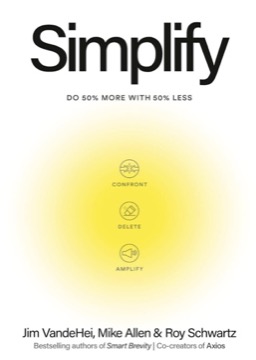
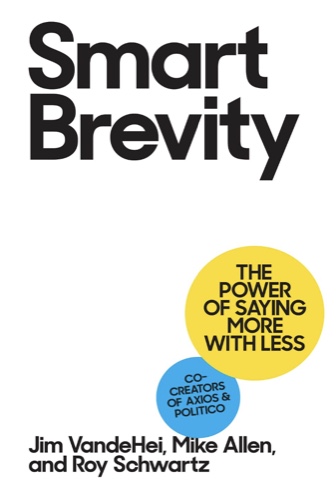
The Elimination Project runs on ideas from the founders of Axios. Simplify tells us how to decide what to stop. Smart Brevity tells us how to say so, clearly enough that people act on it. Both have chapter-by-chapter deep dives in the Innovation Library.

Simplify in the Library Smart Brevity in the Library

How we decide what to stop.

Complexity is the default. Every report, meeting, and approval arrived with a good reason, and almost none of them ever leave. Simplify gives three tools for pushing back. We use all three.

1

Confront

Ask why about everything, especially the things nobody questions anymore. That flicker of dread when a task shows up is a signal, not a mood.

“You can save months or years with one simple word: Why?”
2

Delete

Ask “What can we stop doing?” before “What should we add?” Sunk cost and affection keep bad work alive long after it stops paying off.

“The most important button on your keyboard is delete. Use it with abandon.”
3

Amplify

Deletion creates a void. Fill it on purpose, with the work only our people can do. Every hour we return should go to the mission, not to new busywork.

“In the AI era, ‘average’ is a death sentence.”

The two questions

Before anything else, put these to the thing in front of you:

  1. Would it matter if we didn’t do it?
  2. Would anyone miss it if it were gone?

If both answers are “not really,” you’ve found slop, the self-made busywork that feels like progress and isn’t. Simplify, Ch. 8 — Slop →
Four options for anything.

Once you’ve confronted a task, Simplify says you have four moves: stop it, do it less often, delegate it, or simplify it. Here’s how that maps onto the decisions this team publishes.

Simplify’s moveOur decisionWhat it looks like
Stop itEliminatedThe report, form, or meeting ends. The hours go back to the people who did it.
Do it less oftenModifiedMonthly becomes quarterly. Weekly becomes as-needed.
Simplify itModified ConsolidatedFewer fields, fewer approvers, fewer steps. Or fold two overlapping things into one.
Delegate itModifiedMove it to the right owner, or let a tool do it. AI should subtract work, not add it.

Stop till they squawk

Not sure whether something matters? Pause it, and restore only what people actually miss. When AT&T tried this with its internal reports, most of them never came back.

“Two-thirds of those reports were never missed—and never came back”

Ask the people doing the work

The people filling out the form know which parts are pointless. That’s why anyone can submit here, anonymously if they like, with no gatekeeping.

“If you’re not simple internally, you’re never going to be simple externally.”

Use AI to subtract

AI can bury us in more drafts, more decks, and more options. We point it the other way: the Meeting Test uses AI to find the meeting you don’t need to hold.

“Don’t use AI to add to the pile. Use AI to subtract from it.”

How we say it.

A decision nobody reads hasn’t been communicated. Every submission and every published decision here follows the same three-part shape from Smart Brevity.

1 · The one big thing

One strong sentence: what it is, or what we decided. If people read nothing else, they still know.

2 · Why it matters

One or two sentences of context: who it affects, and what changes for them.

3 · Go deeper

The detail, for anyone who wants it, kept short and skimmable. Depth is an offer, not a requirement.

Audience first

Write for the person who has to act on it, not for the committee that approved it. Picture one real reader.

“We tend to think too much about what we want to say versus what others need to hear.”

ONE big thing

Every decision in the log leads with the call itself. Not the background, not the process. The answer.

“Learn to identify and trumpet ONE thing you want people to know.”

Meetings are decided before they start

Name the decision, write the agenda, invite only the people with a role. If you can’t, it isn’t a meeting. That’s the Meeting Test.

“A good meeting is usually determined before it starts.”

The hard questions come first.

Problem before solution

People bring us solutions before they’ve defined the problem. So we ask, in this order, and we keep asking periodically about the solutions we already run:

  1. Why are we even doing this?
  2. What’s the problem? Define it well, without naming the solution.
  3. Is it our problem to solve? A bloated organization starts solving problems that aren’t its own, providing oversight “because we can” rather than because it’s strategic.
  4. Do we even need a solution? Some problems are small, rare, or fix themselves.
  5. Only then: how might we solve it?

Don’t try to solve every problem.

Teams are tables

Invite people to the table who have something to contribute: the people actively working on the project. Not someone’s supervisor, and certainly not the supervisor’s supervisor. If someone’s there for their information, that could have been an email.

Tables are built around projects

Every team should be able to say: “We’re coming together to work on this project, for this long, toward these outcomes, measured by this.” Fixed scope and an end date are the default. Perpetual teams should be rare.

Information? Stand up.

If you need an information meeting, make it a frequent standup: everyone stands, one minute each on a ruthless timer, follow-ups only for the people who need more. Do that, and most everything else happens outside of meetings.

Standup timer →

Pick one thing this week.

Submit something

A report nobody reads. A form that asks for what we already have. Run the two questions, then send it in.

Submit →

Test a meeting

Before you send the invite, find out whether it should be a meeting at all.

Meeting Test →

Read the decisions

See what we stopped, what we kept, and the reasoning behind each call.

Decision Log →